How to write a marketing brief that leads to useful work
A focused brief connects the buyer’s situation, one objection, one customer action and the conditions for approval. Here is how to write one, then use it to judge the work.
By the Brandora team · · 7 min read
“We need to do more marketing” is a starting point. It is not a brief.
It leaves the important decisions unresolved: who the work should reach, what is stopping that person from buying, and what they should do next. Ask for posts at that stage and you still have to make those decisions when the drafts arrive.
For an owner-led business, the useful handoff is not simply getting someone else to write. It is turning a business need into work you can review without rebuilding the thinking behind it.
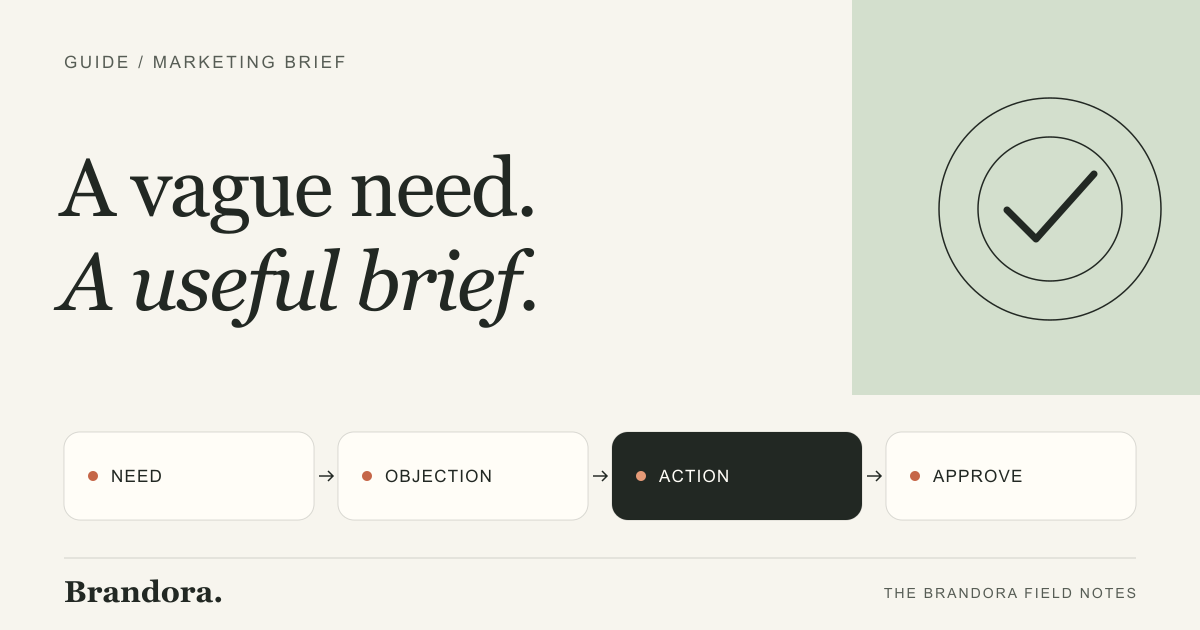
A focused marketing brief connects four things: the buyer’s situation, an objection, an intended action and the conditions for approval. Here is how to write one, then use it to judge the work.
Start with the business need, not the format
“Create an Instagram carousel” specifies a deliverable. It does not explain its job.
Start one step earlier. What needs to happen in the business, and where could marketing help?
For example, imagine a small furniture brand whose owner wants prospective buyers to understand how to choose a dining table for a compact room. This is an illustrative scenario, not a Brandora customer or a measured result.
The request could be “make a carousel about our tables.” A more useful brief would say: “Help people furnishing a small dining area decide whether our table will fit comfortably, then direct them to the product’s dimensions.”
Now there is something to work with. The content needs to resolve a fit question, not just display attractive furniture.
Describe the need in a sentence before choosing the format. If the sentence only names an output, such as an article, a video or an ad, the commercial job is still missing.
Choose one buyer situation and one objection
A broad audience label does not provide much direction. “Small business owners” could include someone choosing their first tool and someone replacing an established system. They have different questions.
Describe the situation that makes the work relevant now. For the furniture example, that might be someone who likes a table but is unsure whether there will be enough room to pull out the chairs.
The objection is specific: uncertainty about usable space. It is not automatically price, product quality or delivery time.
That distinction changes the work. A discount does not answer a dimensions question. A lifestyle image might show the table beautifully without helping the buyer assess clearance.
Use real customer questions when you have them. If you do not, label the objection as an assumption to test. Do not turn an owner’s hunch into “what our customers say.”
A brief does not need to solve every objection. Pick the one this piece will address and record what is out of scope.
Give the work one primary customer action
Choose what the reader should do after engaging with the piece. That might be checking dimensions, comparing options, reading a service explanation or requesting a conversation.
The action should follow naturally from the question being answered. Someone checking whether a table fits needs access to accurate measurements. Asking them to book a sales call instead adds a step that the brief has not justified.
For the hypothetical furniture brand, the primary action is to view the table’s dimensions on its product page. The owner should confirm that those details are present and that the destination works before approving the call to action.
Avoid giving every piece three equal jobs. “Follow us, browse the collection and contact us” leaves the reviewer deciding which action matters. Name the primary action in the brief. Treat other possible actions as secondary.
This is a decision about purpose, not a promise of conversion. A clear next step gives the work a direction. It does not guarantee that anyone will take it.
Write a brief someone can act on
Keep the brief short enough to use, but specific enough to resolve the important choices. A practical version contains these fields:
- Business need: What problem should this work help address?
- Buyer situation: Who is it for, and what are they trying to decide?
- Primary objection: What uncertainty or concern should the piece answer?
- Intended action: What should the person do next, and where?
- Deliverable: What needs to be produced for this assignment?
- Approved facts and assets: What information and materials can the work use?
- Approval criteria: What must be true before the work can go live?
- Boundaries: Which claims, promises and topics are excluded?
Here is the furniture example condensed into a usable brief:
Example brief
Create one draft carousel for people choosing a dining table for a compact room. Address uncertainty about table size and chair clearance. Use only the owner’s supplied measurements and approved product images. Help the reader understand what to measure, then direct them to the product dimensions. Do not claim the table fits every small room. Approval requires accurate measurements, legible instructions, an accurate visual and a checked destination link. If a necessary measurement is missing, flag it rather than estimate it.
Notice what this does not contain: a demand for “engaging content” or an instruction to “make it convert.” It names the question, the evidence and the next step.
Assign specialists to the problem, not the org chart
Not every brief needs every discipline.
If the assignment is a social explanation using approved product facts, the core work may be social framing and creative. If it is an article intended to answer a search question, SEO input may be relevant. If the buyer objection is uncertain, research may come before production.
In Brandora, Mel coordinates strategy, Luke covers SEO, Riley market intelligence, Danny creative and ads, and Vee social. Those roles provide a way to think about the contribution a task needs. They are not a reason to expand a straightforward assignment into five separate projects.
Keep the same brief attached to the work through each contribution. Creative should not quietly introduce a different promise, and the call to action should not change simply because a format makes another button convenient.
If a specialist uncovers a missing fact, bring that gap back into the brief. Do not bury it beneath polished copy.
Make approval a check against the brief
“Do I like it?” is a reasonable reaction. It is not a complete approval process.
Check whether the draft answers the selected objection, uses approved facts and leads to the intended action. Then check the execution: can the reader understand the point, are the visuals accurate, and does the destination support the promise?
In the furniture example, an attractive carousel should still be held back if it shows an unsupported clearance measurement. A clear explanation should still be revised if its final slide sends people somewhere without dimensions.
Write feedback against the brief: “The draft explains table width but does not address space for pulling out chairs.” That is more actionable than “It needs more impact.”
Brandora keeps each brand in an isolated workspace, and work enters an approval queue before publishing. The practical principle is straightforward: a prepared draft is not permission to publish. The owner retains the final decision.
Separate delivery quality from business results
After approval and publication, review what happened against the intended action, using whatever reliable evidence is available.
A delivered piece establishes that work was produced. It does not establish that buyers understood it or acted on it. Equally, a lack of recorded actions is hard to interpret if the destination was broken or tracking was unavailable.
Check delivery and measurement before drawing conclusions. If the work reached relevant people but did not prompt the intended action, revisit the objection, explanation and next step. Record what is known and what remains uncertain.
The brief is not a document to file away. It is the reference point for the next decision.
Start with the request you already have
Take the next vague request on your list and rewrite it in this form:
One-sentence brief
Help [buyer in a specific situation] resolve [one objection], so they can [one next action]. Use [approved evidence]. The work is ready for approval when [clear criteria].
You do not need a longer content calendar to complete that sentence. You need a decision about what the work is for.
Make that decision first. Then you can hand over a focused assignment, review the result against a shared standard and keep control without rewriting every draft yourself.
Marketing brief questions
What should a marketing brief include?
The business need, the buyer’s situation, one primary objection, the intended action and the deliverable. Add the approved facts and assets the work can use, the approval criteria and the claims or topics that are out of bounds.
Should one piece of marketing answer every objection?
No. Pick the one objection this piece will address and record what is out of scope. A discount does not answer a question about fit, so the objection decides what the work needs to show.
How do I approve work against a brief?
Check whether the draft answers the selected objection, uses approved facts and leads to the intended action. Then check the execution. Write feedback against the brief, not as a general request for more impact.
Brandora · 7-day free trial
Write the brief. Approve every piece.
Give Brandora your brand and the next request on your list. Nothing goes out until you approve it. 7-day free trial, cancel anytime.