AI marketing team: roles, workflow and human oversight
What an AI marketing team does, where people stay accountable, and how to organize a weekly delivery cycle for each client.
By the Brandora team · · 5 min read
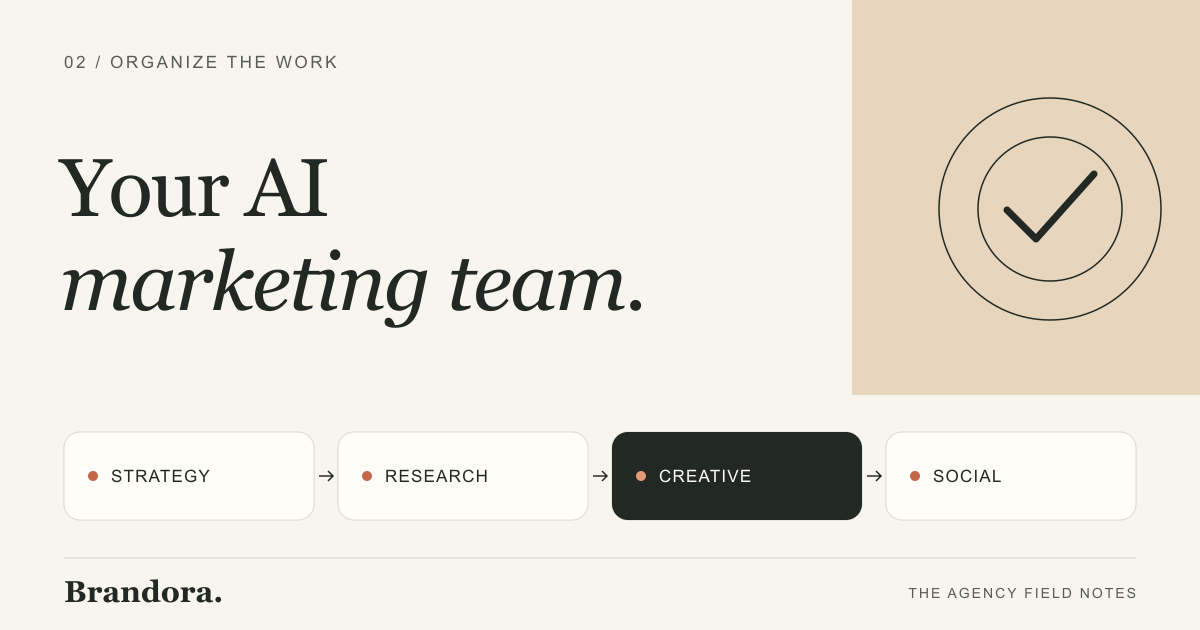
What is an AI marketing team?
An AI marketing team is a coordinated set of AI-assisted roles that help plan, research, create and distribute marketing. In software, these roles may be implemented as specialist agents working from shared brand context. People still set objectives, verify claims, approve work and decide what changes when results arrive.
The phrase can also describe a human marketing department that uses AI tools, or an outsourced service. Those are different buying decisions. Here, we explain the software model and how an agency can use it. Brandora uses this model, so the examples describe our approach rather than a universal definition of how every vendor works.
Give each role an input, an output and an owner
A collection of named assistants is not automatically a coordinated team. Coordination means one role’s work becomes useful input for the next, with the same offer, audience and constraints intact. Specify what each role receives and what a person must accept before the work moves on.
| Role | Deliverable and human responsibility |
|---|---|
| Strategy | Turns the brief into a proposed objective, message and content plan. The account lead checks that the plan matches the client’s priorities. |
| Research | Collects competitor activity, audience questions and source material. A person verifies facts and separates observations from guesses. |
| Search and content | Proposes topics and drafts useful answers. An editor checks search intent, sources, originality and product accuracy. |
| Creative | Develops copy, images or video from approved inputs. A reviewer checks product details, visual identity and asset suitability. |
| Social delivery | Adapts approved material for each channel and organizes publication. A person confirms accounts, formats, timing and final approval. |
| Performance review | Organizes available results for the next planning cycle. The strategist decides what the numbers justify changing. |
In Brandora, Mel covers planning, Riley research, Luke search, Danny creative and Vee social. These are software roles. Their names make the division of work easier to follow; they do not mean that a human specialist has independently checked every output. The agency product page explains the current workflow.
Start with a shared brand brief
The most useful brief contains decisions, not just adjectives. “Friendly and premium” leaves room for many interpretations. An approved example, a specific audience problem and a list of forbidden claims give reviewers something concrete to work against. Keep confirmed facts separate from proposed ideas so an attractive draft does not turn an assumption into a product promise.
Brief for one client workspace
Client and offer: Audience and problem: Objective for this campaign: Confirmed product facts and source links: Approved voice examples: Claims or topics to avoid: Approved assets: Channels and required formats: Reviewer and approval deadline: What success will be measured against:
Keep one brief per client and update it when the offer changes. A seasonal promotion ending on Friday must not survive in next week’s drafts. Assign one person to maintain this information, even if several people contribute. For a wider evaluation of brand context and client separation, use the AI marketing platform scorecard.
An example weekly AI marketing team workflow
Consider an illustrative coffee brand promoting a new seasonal drink. The goal is to give nearby customers a reason to visit, with one approved offer and a small number of posts. This example is an operating template, not a customer case study or a promise about output volume.
- Plan: the account lead confirms the offer, availability and objective. The strategy role proposes a focused content plan, and a person removes ideas that do not fit.
- Research: gather relevant audience questions and competitor examples. Keep the source beside each factual observation; do not copy another brand’s creative or assume its visible engagement proves sales.
- Produce: create a first batch from the approved plan and real product assets. Adapt the message to each destination instead of repeating the same caption everywhere.
- Review: check product accuracy and creative quality internally, then send the agreed version to the client. Collect specific revision requests and keep publication blocked until the right reviewer approves.
- Deliver: confirm the destination account, publish time and channel requirements. Check the actual publication status instead of assuming approval means delivery succeeded.
- Learn: compare the available results with the objective. Record what you learned and propose the next small test, while keeping uncertain explanations labeled as hypotheses.
Set the review window with the client in advance. If approval arrives late, move the publication time rather than treating silence as permission. Our social media approval workflow guide includes a handoff template and checks for edits after approval.
What should stay with people?
Keep decisions with consequences assigned to a named person: what the client is promising, whether evidence supports a claim, whether an asset is appropriate and whether a campaign should launch. A fluent explanation from an AI system is not evidence that its facts are correct. Source checking must be part of the workflow, not an occasional cleanup step.
Review generated creative against the original assets too. Packaging, logos and product details can drift. For creative inspiration, our AI advertising examples distinguish official brand work from spec and commentary examples. Use references to discuss a direction, then judge your own deliverable against the client’s actual requirements.
Measure capacity and quality separately
Track time from brief to approved deliverable, number of revision rounds and the share of work that reaches publication as planned. Separately track campaign outcomes such as qualified inquiries or purchases when you can attribute them responsibly. Faster production is useful, but it is not the same measurement as more effective marketing.
Start with one client and one repeatable service. Expand only when the handoffs are clear and review remains manageable. If the agency spends more time fixing drafts than it saves, improve the brief or narrow the task before increasing output. An AI marketing team should make accountability easier to see as delivery grows.
AI marketing team questions
Is an AI marketing team the same as an AI marketing agency?
No. A software team consists of AI-assisted roles inside a product. A marketing agency is a service business with people and a delivery agreement. A human agency can use an AI marketing team as part of its service.
How many AI agents does a marketing team need?
There is no useful universal number. Define the jobs and handoffs first. A small set of roles sharing accurate context can be more useful than many disconnected assistants.
Who approves the work in Brandora?
Brandora’s published workflow lets you review, edit or reject work, approve in bulk, and invite team members or clients into the workspace. Nothing publishes until it is approved.
Does Brandora already run paid ad campaigns automatically?
The dedicated ads agent is coming soon. Studio can create ad creative, which is a separate capability from launching, buying or optimizing paid-media campaigns.
Brandora for agencies
Give each client a coordinated workflow.
Explore Brandora’s specialist roles, client workspaces and approval process before deciding where AI belongs in your delivery.