How to get your first 10 customers (before you automate)
Your first ten customers come from conversations, not campaigns. Here is a manual outreach plan, the questions to ask, and what to learn before automating anything.
By the Brandora team · · 7 min read
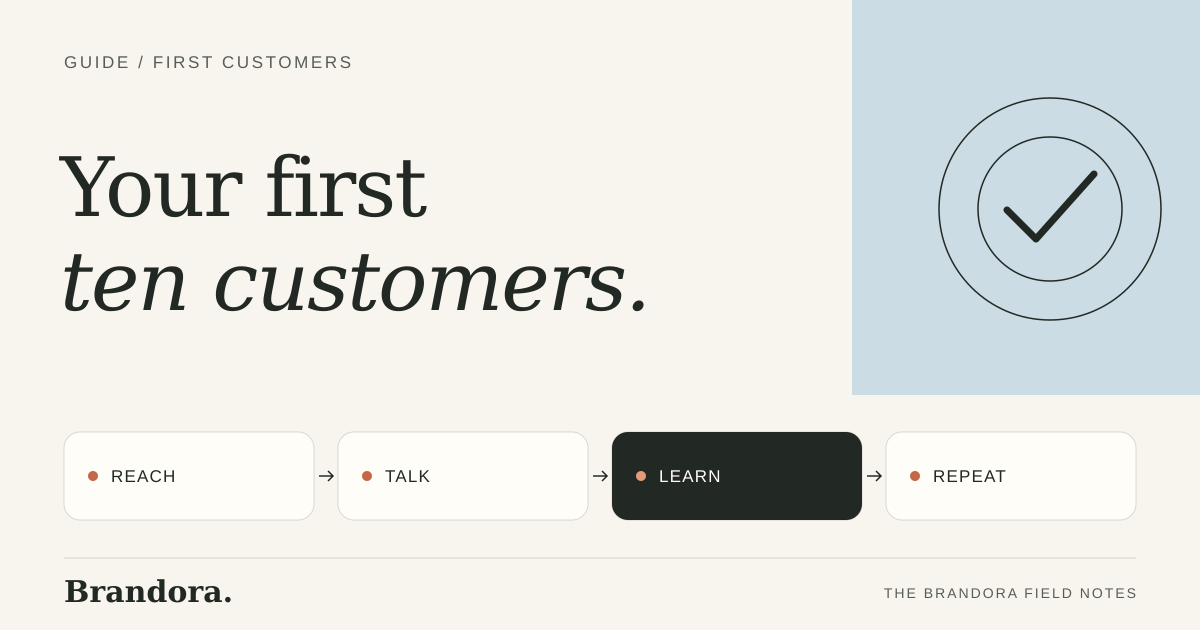
The short answer
- Your first ten customers come from direct, personal outreach: people you know, people they know, and the places your buyers already gather.
- Treat each conversation as research. Write down the problem in their words, what they tried before, and what nearly stopped them buying.
- Automate only after you can describe the buyer, the objection and the message that worked. Then Brandora can turn those words into weekly posts and ads.
Why the first ten should be manual
Paul Graham's essay Do Things That Don't Scale made the point well: early on, founders should recruit users by hand, one at a time. The reason is not only that it works. It is that each conversation teaches you who buys, why and what stops them. Automating before you know that just makes the wrong message travel further.
Who to contact first
- People who already told you they have the problem.
- Your own network: past colleagues, clients, suppliers and friends in the right field.
- Second-degree introductions: ask each person for one name.
- Places your buyers already gather: local groups, industry forums, marketplaces, events.
- People who engage with posts about the problem, contacted personally, not with a template blast.
A short outreach script
First-customer outreach message
Hi [name], I'm building [what it is] for [who it is for] who struggle with [the problem]. I'm talking to a few people before we open it up. Would you have 15 minutes this week to tell me how you handle [the problem] today? Happy to show you what we have, and no pressure to buy.
Keep it personal and specific. Name why you thought of them. Ask for a conversation, not a purchase.
What to learn from each conversation
| Question | Why it matters later |
|---|---|
| How do you describe the problem? | Their words become your headlines and posts |
| What have you tried already? | Tells you who you really compete with |
| What nearly stopped you buying? | The objection your marketing must answer |
| Where do you look for solutions like this? | Tells you which channel to start with |
| Who else has this problem? | Your next introduction, and your audience definition |
Keep notes in one place. After ten conversations, the patterns are usually obvious: the same phrases, the same objection, the same places people look.
After someone says yes
- Deliver personally. Early customers forgive rough edges when they can reach the founder.
- Ask what made them buy, and write it down word for word.
- Ask permission before quoting them anywhere, and never invent a review.
- Ask who else they know with the same problem.
These notes become the raw material for your first marketing brief: the buyer, the objection and the action, in your customers' own words.
When to start automating
- You can describe your buyer in one sentence, in their words.
- You know the main objection and how to answer it.
- You know which channel your buyers use.
- Several customers bought for the same reason.
Once those are true, write them into a startup marketing strategy: one offer, one audience, one channel. That is the point where producing content every week starts to pay off.
Brandora · 7-day free trial
Ready to go beyond one-to-one?
Give Brandora your website and what you learned, and it drafts weekly posts and articles in your buyers' words, published only when you approve. 7-day free trial.
How Brandora picks up from there
Brandora for startups turns that early learning into a steady presence. Mel builds the strategy around your buyer and offer, Vee drafts and publishes social posts, and on Growth Luke briefs articles for the questions your buyers search. Everything waits for your approval. The Brandora pixel then ties each visit, sign-up, demo booking and lead to the piece that brought it, so you keep learning at scale the way you did one conversation at a time.
First customers FAQ
How do I get my first 10 customers?
Reach out personally to people who have the problem: your network, introductions from them, and places your buyers already gather. Ask for a short conversation, not a sale, and learn from every one.
Should I run ads to get my first customers?
Usually not first. Ads amplify a message, so they work better once direct conversations have shown you who buys, why and what stops them.
When should a startup automate its marketing?
When you can describe the buyer, their main objection and the channel they use, and several customers bought for the same reason. Then weekly content and automation have something proven to build on.
Brandora · 7-day free trial
Scale what your first customers taught you.
Weekly posts and articles built on your buyers' words, approved by you, with every sign-up traced to its source. 7-day free trial.