Startup marketing strategy: one offer, one audience, one channel
Early-stage marketing works when it is narrow. Here is a 30-day plan built on one offer, one audience and one channel, and how to know when to widen it.
By the Brandora team · · 8 min read
The short answer
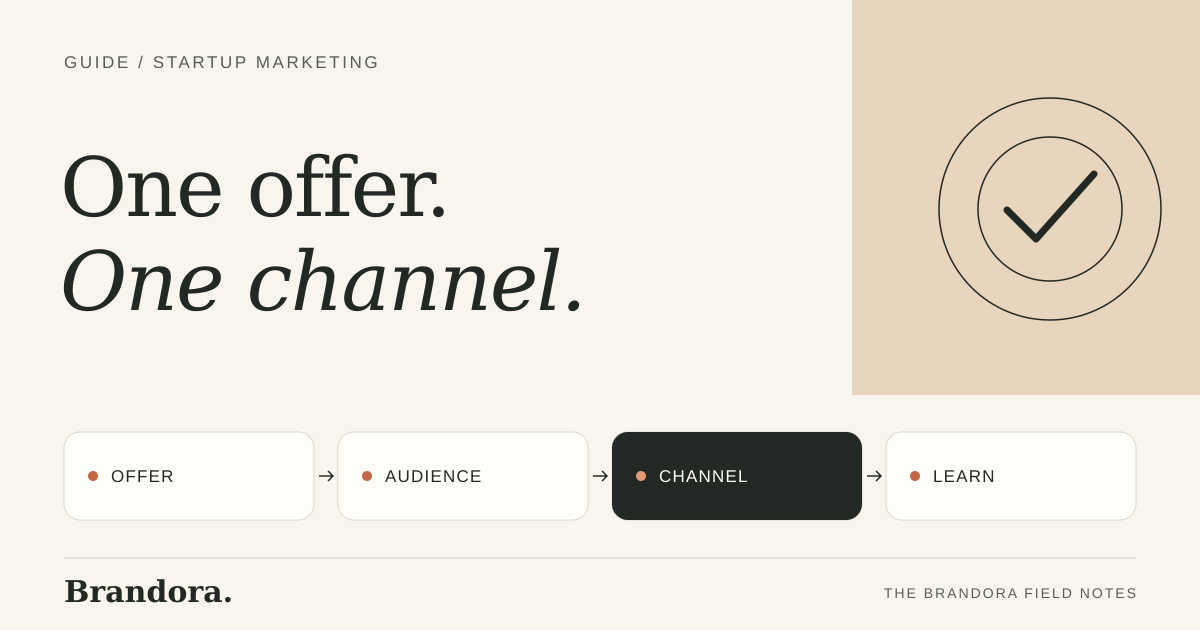
- A startup marketing strategy should be narrow: one offer, one audience and one channel, run for 30 days before adding anything.
- Measure one action that signals real interest, such as sign-ups, demo bookings or replies, not followers or impressions.
- Widen only after the first channel shows a repeatable result. Brandora for startups keeps that channel fed every week and ties each sign-up and demo to the post that brought it.
Why early-stage marketing has to be narrow
A startup has less time, less money and less brand recognition than the companies it competes with. Spreading that across five channels and three audiences guarantees that none of them gets enough attention to work, and that you cannot tell what did.
Narrow is not small. It is a way to learn quickly. One offer, one audience and one channel give you a clean read in a month. Then you can widen with evidence instead of hope.
The three choices
| Choice | How to make it | Example |
|---|---|---|
| One offer | The thing you can deliver well today, with a clear next step | A free 20-minute setup call for a scheduling tool |
| One audience | A group with an urgent problem you understand and can reach | Owners of two-chair hair salons who lose bookings to no-shows |
| One channel | Where that audience already pays attention and you can show up weekly | LinkedIn for B2B founders, Instagram for local services |
The example is illustrative, not a Brandora customer. If you do not yet have any customers, start with how to get your first 10 customers. Manual conversations come before a channel strategy.
A 30-day startup marketing plan
- Days 1 to 3: write the one-sentence positioning. Who it is for, the problem, and why you, with proof you can show.
- Days 4 to 7: publish three posts that each answer one real question your audience asks. Use their words, from calls or comments.
- Week 2: publish three more and add one longer piece, such as a short article or a walkthrough, that a post can link to.
- Week 3: look at which posts brought visits, sign-ups or replies. Make two more in the same angle and drop the weakest angle.
- Week 4: repeat what worked, then write down what you learned: the angle, the format and the action that moved.
Weekly startup marketing check-in
Week: Posts published and angle of each: Visits from each post: Sign-ups, demos or replies from each post: Best angle this week: What to make more of next week: What to stop:
Brandora · 7-day free trial
Keep one channel fed, every week.
Brandora plans and drafts your posts and articles each week, publishes what you approve and shows which ones brought sign-ups and demos. 7-day free trial.
What to measure
Pick one action that signals real interest and track it per piece of content. For a product with self-serve sign-up, it is sign-ups. For a sales-led product, demo bookings. For a service, replies or calls booked. Followers and likes can be early signals, but they are not the goal.
This is where most early teams lose the thread: a sign-up arrives and nobody knows which post brought it. Brandora solves that with its pixel. Add it to your site once, and every post and article Brandora sends out carries its own tracking link, so each visit, sign-up, demo booking and lead traces back to the piece that brought it.
When to widen the strategy
- The channel brings your target action every week, not just once.
- You can name the angle and format that work, and repeat them.
- You have the time or help to keep the first channel going while you test a second.
When all three are true, add one channel or one audience, not both. Our small business social media strategy guide covers choosing a second channel.
Startup marketing strategy FAQ
What is the best marketing strategy for a startup?
A narrow one: one offer, one audience and one channel, run for 30 days with one measurable action per piece of content. Widen only after the first channel shows a repeatable result.
How should an early-stage startup start marketing?
Start with direct conversations with potential customers, then publish weekly on the one channel where they already pay attention, answering the questions they actually ask.
How do I know if my startup marketing is working?
Track one action that signals real interest, such as sign-ups, demo bookings or replies, per piece of content. Brandora's pixel ties each of those to the post or article that brought it.
Brandora · 7-day free trial
Marketing for founders with no time for it.
Strategy, posts and articles every week, approved by you, with every sign-up and demo traced to its post. 7-day free trial.