AI tools for marketing agencies: a practical shortlist
Compare tools by the work your agency needs to deliver, then test a small stack against a real client brief.
By the Brandora team · · 5 min read
Which AI tools should a marketing agency evaluate?
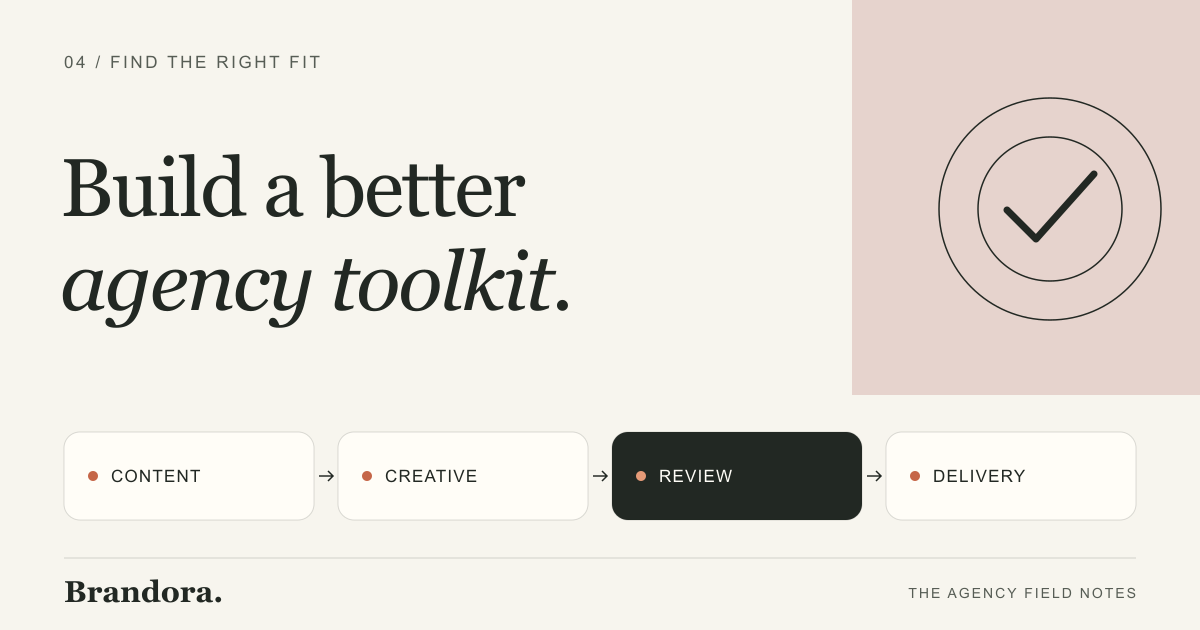
Choose AI tools for marketing agencies by the bottleneck: marketing content, creative production, client review or delivery across accounts. Jasper is a candidate for marketing content workflows, Brandora Studio for creative production, and Brandora for coordinated client marketing. Buffer and Planable are useful workflow tools to evaluate alongside AI production when review and publishing are the bottleneck.
This shortlist is published by Brandora and includes our products. It is based on the official pages linked below, checked on October 23, 2026, rather than hands-on testing of every tool. The list is deliberately small and is not a universal ranking. We leave pricing and plan limits to each vendor’s current documentation because eligibility matters more than an attractive entry price.
A shortlist organized by the job
| Candidate | Why evaluate it, and what to test |
|---|---|
| Jasper | Its public platform describes marketing agents, brand context and content pipelines. Test a real campaign brief and the controls needed to keep each client’s content accurate. |
| Brandora Studio | Creative production from brand and product inputs. Test a static ad or product video against the original assets, then review the available output formats. |
| Brandora | Client workspaces, specialist AI roles and approval before publication. Test one client campaign through production, review and delivery. |
| Buffer | A social workflow companion: its collaboration page documents drafts, notes, approvals and a shared calendar. Test the roles and publishing process your team needs. |
| Planable | A review workflow companion: its help center documents individual and bulk approval requests. Test the client’s review journey and required approval settings. |
Sources for those descriptions: Jasper’s platform, Brandora Studio, Brandora for agencies, Buffer collaboration, and Planable approval requests. The review tools are included for their documented workflow capabilities; the table does not imply that every listed tool is an autonomous AI marketing team.
Choose a stack for your actual service
For an agency selling editorial content, start with the brief, research, drafting and editing workflow. A tool such as Jasper is worth evaluating when you need marketing-specific brand context and repeatable production. Keep source verification and final editing assigned to people, then check how approved work reaches your publishing system.
For an agency selling product creative, test Studio using a real client asset and a concrete brief. Check the product’s shape, colors, label and logo against the original. A striking image that changes the product is not an acceptable deliverable. Our product photo prompt guide offers a starting reference for briefing and reviewing AI images.
For an agency whose drafts are already strong, adding more generation may increase the review backlog. Evaluate the approval and calendar workflow first. A dedicated tool can be useful when feedback is spread across email, messages and spreadsheets. Use the social media approval tool checklist to test the process with the people who will use it.
For an agency repeating the entire marketing workflow across clients, compare a coordinated platform with your current stack. Brandora is designed around that use case. Verify client separation, shared context and publication controls, and check which remaining tools you would keep. Do not remove a reporting or project-management product until its job is demonstrably covered.
Give each candidate the same test brief
A fair evaluation starts with the same inputs. Choose a normal client campaign and define what an acceptable deliverable looks like before you see the output. Use approved facts and assets, a clear channel requirement and a realistic review deadline. Otherwise, the tool with the most polished sample may win a test that has little to do with your work.
- Document the current process: how many handoffs, revision rounds and human minutes are needed for one approved campaign?
- Set acceptance criteria: which facts must be correct, which assets must remain unchanged, and who can approve publication?
- Run the same brief: keep the input quality and deliverable scope consistent across candidates.
- Record interventions: include re-prompting, manual formatting, asset repair, exporting and copying between tools.
- Test the handoff: move the final asset to the actual reviewer and publishing destination. Generation is only one part of delivery.
- Decide on evidence: choose the option that improves your bottleneck while meeting the mandatory requirements, then repeat with another client before expanding.
Count the tools and labor that remain
A new subscription does not automatically replace an old one. List each product you would keep after adoption and the task it still performs. Pay particular attention to client reporting, approvals, analytics and agency operations. Include the time spent managing the connections between products.
Tool evaluation worksheet
Task and client: Current monthly tool cost: Proposed subscription and usage cost: Other tools that remain: Current human hours per month: Pilot human hours, including corrections: Approved deliverables produced: Mandatory requirements passed or failed: Reason to keep, reject or retest:
Separate delivery efficiency from marketing performance. A tool can reduce production time without improving reach, qualified inquiries or sales. Measure campaign outcomes on their own terms, and avoid extrapolating a single successful post into a return-on-investment claim.
Questions to answer before buying
- Can each client’s information and connected accounts be kept separate, and can you verify the invited client’s access?
- What happens to an approved asset after someone edits it? Does your process require another review?
- Which channels and formats are directly supported, and which require a manual handoff?
- What happens when usage reaches the plan limit or a publication fails?
- Which parts of the client experience can carry your agency’s brand? Output, reports and software branding are separate requirements.
For the last question, use the white label marketing software guide. Brandora supports client-branded published output without its signature; agency-branded reports are not available yet. The dedicated ads agent is also coming soon, so do not evaluate the current product as an autonomous paid-media buyer.
Agency AI tool questions
What is the best AI tool for a small marketing agency?
There is no single best tool for every service. Choose the bottleneck first, then test one client brief through the full workflow. Content production, creative work and approval coordination can require different products.
Should an agency use one platform or several tools?
Use one platform when it covers your required workflow well enough to reduce handoffs. Keep specialist tools when they solve a job the platform does not cover. Compare the total cost and human work of both options.
Are approval tools AI marketing tools?
They may include AI features, but their role in this shortlist is workflow control. Review and publishing tools can make AI-generated work usable without being the system that generates it.
How should an agency calculate AI tool ROI?
Start with observed changes in subscription costs, usage and human delivery time for comparable approved work. Track revenue outcomes separately and avoid attributing them to the tool without supporting evidence.
Brandora for agencies
Test the workflow your agency sells.
Explore Brandora’s agency setup and bring one representative client brief to see where it could fit your stack.