AI marketing agents: what they do and how they differ
What an AI marketing agent actually does, how it differs from a chatbot and from a coordinated team of agents, and how to choose the right kind.
By the Brandora team · · 9 min read
The short answer
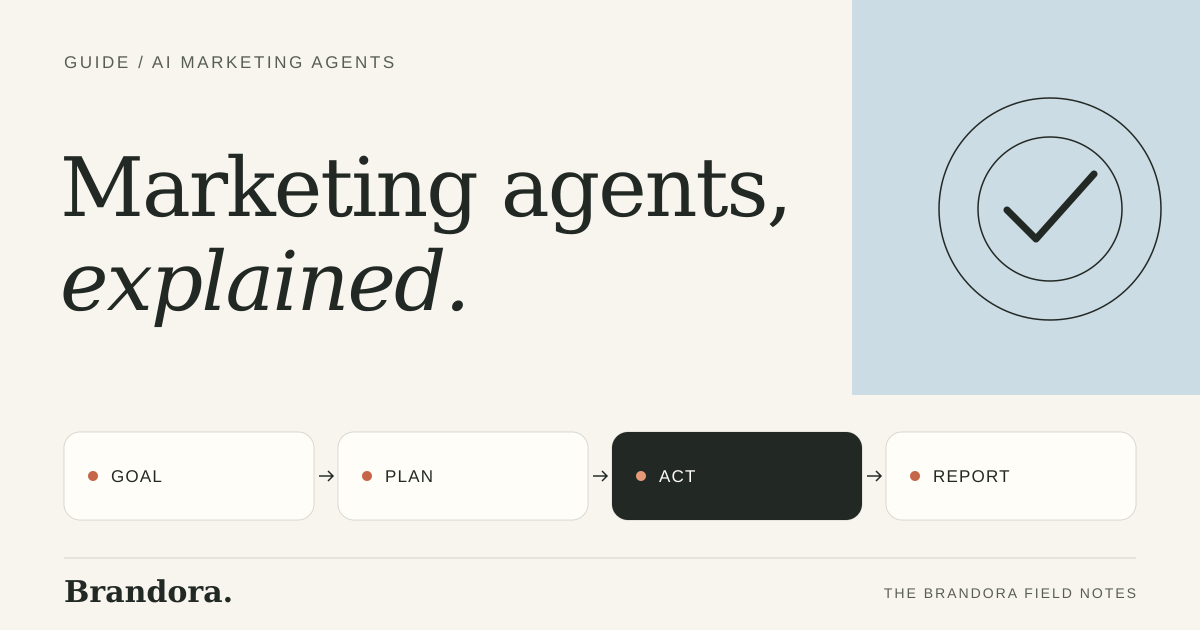
- An AI marketing agent is software that takes a marketing goal, plans the steps and carries them out with tools, such as researching competitors, drafting posts or launching an approved ad, instead of only answering a prompt.
- A chatbot answers. A single agent completes one job. A coordinated team of agents shares one brief and hands work between specialists, from strategy to publishing to results.
- Brandora is a coordinated team of six specialist agents for one brand, with human approval before anything goes live.
What is an AI marketing agent?
An agent is an AI system that works toward a goal over several steps. It decides what to do next, uses tools such as search, analytics or a publishing connection, checks the result and continues. In marketing, that means an agent can take "prepare next week's social posts for our winter offer" and come back with researched, drafted and scheduled posts, rather than one paragraph of text.
How are AI agents used in marketing?
- Research: watching competitor sites and ads, and summarising what changed.
- Search: finding questions people search for and briefing articles to answer them.
- Content and creative: drafting posts, ad copy and images from brand guidelines.
- Social: building a calendar, drafting posts and publishing approved ones.
- Paid ads: reading campaign results, proposing changes and launching approved campaigns.
- Reporting: tying visits, leads and sales back to the piece that brought them.
Chatbot, single agent or coordinated team
| Compare | Chatbot | Single agent | Coordinated agent team |
|---|---|---|---|
| What you give it | A prompt | A task | A goal and a brief |
| What you get back | Text or an image | One finished job | A plan, the work, publishing and results |
| Memory of your brand | Whatever you paste in | Usually per task | Shared brief every specialist works from |
| Uses tools | Sometimes | Yes, for its job | Yes, across research, creative, publishing and ads |
| Who checks the work | You, every time | You, per task | You, in one approval queue |
| Best for | One-off drafts | One repeated job | Running marketing week to week |
The difference that matters most is coordination. Five separate tools can each produce good work and still contradict each other: an ad promising one thing, a post another and an article a third. A coordinated team keeps every specialist on the same offer, audience and facts. Our guide to the AI marketing team goes deeper on how those roles divide the work.
The kinds of AI marketing agent products
- General assistants with agent features, such as ChatGPT, useful for research and drafts when you supply the context each time.
- Agents inside large marketing suites, such as the CRM and marketing cloud vendors, built for companies already running those platforms.
- Single-job agents, for example tools that only make ad creative or only optimise ad accounts.
- Coordinated agent teams for a brand, such as Brandora, which run the weekly work across channels from one brief.
Enterprise suites make sense when your customer data already lives there and you have a team to configure it. Owner-led businesses, startups and DTC brands usually need the work done more than they need a platform to configure.
Brandora · 7-day free trial
Six specialists, one brief, your approval.
Brandora's agents plan, create, publish and read results for your brand, and nothing goes live until you approve it. 7-day free trial.
Brandora's agents
| Agent | Role |
|---|---|
| Mel | Head of Marketing. Sets the plan and keeps every specialist on track. |
| Luke | SEO and search. Finds the questions worth answering and briefs the work. |
| Riley | Market intelligence. Watches competitors and flags what moves. |
| Danny | Creative and ads. Builds the creative and writes the copy. |
| Vee | Social media. Runs social from calendar to published post. |
| Cam | Performance marketer. Reads your Meta ads, launches approved campaigns and says what to keep or cut. |
Starter ($99 a month) includes Mel, Vee and Danny. Growth ($299 a month) adds Luke, Riley and Cam, plus Meta ad launch. Every piece waits in one approval queue, and the Brandora pixel ties each visit and sale to the piece that brought it. See the AI marketing workflow for how a campaign moves through them.
How to choose an AI marketing agent
- Name the job you want gone: one task, or the weekly marketing as a whole?
- Check where it gets your brand context, and whether every task uses the same brief.
- Check the control points. Can anything publish or spend money without your approval?
- Check the proof. Can you see which piece brought a visit, lead or sale?
- Test it on one real offer for two weeks before committing.
AI marketing agents FAQ
What are AI marketing agents?
AI systems that take a marketing goal, plan the steps and carry them out with tools, such as research, drafting, publishing and reporting, rather than only answering a single prompt.
How are AI agents used in marketing?
For competitor research, search research and article briefs, drafting posts and ads, running a social calendar, reading and launching ad campaigns, and tying results back to each piece of content.
What is the difference between an AI agent and a chatbot?
A chatbot answers a prompt. An agent works toward a goal over several steps and uses tools to complete the job. A coordinated team of agents shares one brief across specialists.
Are AI marketing agents safe to let publish?
Only with a control point. Look for an approval step before anything is published or any money is spent. In Brandora, nothing goes live without your approval.
Brandora · 7-day free trial
Put a team of marketing agents to work.
Six specialists on one brief, with your approval before anything goes out. Try Brandora free for 7 days.